The Mundane Path

Recently I was re-introduced to the story of Naaman - a man in the Bible who was seeking healing for his leprosy. Naaman goes to see Elisha, the prophet of the day, who tells him to wash seven times in the Jordan to be healed. Naaman responds with anger, saying "Behold, I thought, ‘He will surely come out to me and stand and call on the name of the Lord his God, and wave his hand over the place and cure the leper.’" He also proceeds to complain about the chosen body of water. Naaman's servants plead with him saying “My father, had the prophet told you to do some great thing, would you not have done it? How much more then, when he says to you, ‘Wash, and be clean’?”

While is passage is specifically about healing, I garnered two observations that were applicable to any process of change or growth.

Often times, the process is not what we expect it will be.  We may have an exact image in our minds of what a certain path in our lives is meant to look like, only to find that we prepared ourselves for the wrong thing. And like Naaman, we can get mad and resist this different process. Or, like Naaman's servants, we can choose to accept this unexpected path. I mean, if the end result is going to be the same - if I am going to be healed or changed or matured using the unexpected path, what's the use in getting angry that it's not happening the way I thought it would?

We often desire a path that is more spectacular than the reality.  Naaman wanted the prophet to wave his hand and make magic happen. But the actual path was less exciting. It involved doing something very mundane, and it would not be instantaneous. Now, I know well that there are spectacular stories happening all over the world! These are the stories that get into papers, shared virally, talked about. But I would guess that for every spectacular story, there are at least one million mundane, everyday life events - again, this is just a guess. Unfortunately, the spectacles get our imaginations flowing and whet our appetite, so we desire life to always be spectacular. But it isn't. Life, growth, healing, change - these things are often achieved through repetitive, day-to-day tasks.

Still, while life isn't always spectacular, I do believe life can always be awe-inspiring - just not in the whiz-bang-pow! way we want it to be. As a storyteller, I often try to convey those spectacular life moments in my work. However, the act of crafting those stories exists in the realm of the repetitive and mundane. Sure, I could wait for that hand of God, that muse, that spark of inspiration to flood my soul and almost coerce me to write. But what are the chances of that? And if the end result could still be that I tell a great story, why get angry that the instant spark doesn't occur? Usually, it's me in front of my laptop or my keyboard, with the laundry in the wash, and the realization that I still have yet to shower that day. Thankfully, I'm not required to bathe seven times like Naaman.

Posted on October 15, 2013 and filed under Creative.

Transformative Performance - An Interview with Lindsay Hirata

LindsayHeadshot.jpg

In The Song of the Nightingale, Lindsay Hirata plays the role of Mei Lin, a fish-delivery-girl-turned-kitchen-maid who has her eyes set on moving up in the palace. Lindsay is also a music therapist and is completing her Master's in Integrative Health Studies at the California Institute of Integral Studies in San Francisco. As a therapist, she focuses a lot on the transformative power of the arts, something that I take seriously in my own work as a writer/composer. I asked her to share some of her thoughts on her worlds of music therapy and performance.

 ---

MIN: Can you describe the work you do as a Music Therapist?

LINDSAY: Music therapy is the use of music as a tool for positive change (physical, cognitive, behavioral, social/emotional, spiritual).  I believe strongly in the transformative power of sound and music, and feel incredibly lucky to bring that into my work. There is something very visceral and honest about a musical experience.  It has the possibility to shift so many things in our lives: our thoughts, our awareness, and our ability to listen and to be heard.  

What really excites me is using music to connect people to themselves and to others.  Music, at its core, is a combination of elements strung together in a synchronized way.  I think it facilitates that same process in us when we listen to or engage in it.    

M: Do you find your experience as a performer has helped inform your work in music therapy or vice versa?

L: Definitely!  For a long time, I stopped performing.  I poured myself into learning and growing as a music therapist.  I used music but never “performed."  There seemed to be this negative connotation with it in my mind.  I think what happened is I stopped believing that I had something valuable to share. [The Song of the Nightingale] has really brought me back to my voice and encouraged me to share that with others.  It makes me a better music therapist.  As I get ready to finish grad school and continue to build my work, it’s so important to remember to continue sharing and connecting with others in that very honest way.

M: What themes in The Song of the Nightingale  do you relate to the most? Are those values you also like to incorporate into your therapy work?

L: I read something about performing the other day that really shifted the way I thought about it.  It defined performance as: “transforming something into what it truly can be,” and described it as a process that required subtlety, patience, and precision (Les Mckeown, Inc. Magazine). I loved that perspective. When we think about performance in this way, it becomes an act of optimism and hope in what is possible. It is less about perfection and achievement, and more about a process in transformation. That's how I feel when I am onstage with my fellow cast mates. We are co-creating something in every moment and building something bigger than ourselves.

In my work, I think it is so important to remember what is possible while still continuing on with patience in the process. Meeting people where they are at while holding them up to their highest gifts is a balance that I always want to keep in mind. 

Relating it to the story of Nightingale, I think the characters are all going through a kind of transformation, and the Nightingale is a reminder to continue along this path with faith and optimism.  I hope people who watch the show are inspired to continue looking for what is possible in each day.

Posted on October 8, 2013 and filed under Performing Arts, Nightingale.

Tales of Two Chinas

I am working on writing two shows set in a mythical ancient China right now - The Song of the Nightingale,  which opens next Friday (!!), and Where the Mountain Meets the Moon , which goes into its second workshop come November. I am proud to say that even though the backdrop of these shows could be categorized as the same, they are both very different shows - particularly in their musical styles.

 The Song of the Nightingale  is a sort of homage to the musical theatre composers who came before me. I call it a patchwork of pastiche. Each musical number is a nod to some other composer's or show's style. Nightingale has everything from sweeping ballads to jazzy show-stoppers to rock-inspired rhythms. The actual Song of the Nightingale is more in the realm of an art song - a fully instrumental mini-flute concerto. And the Song of the Fake Nightingale? Well, I won't spoil anything, but it's as far from a flute concerto as you can get. I consider it a compliment when others say they hear [name of composer] in my work. They are probably correct, and I hope I have paid tribute accordingly.

By contrast, for Where the Mountain Meets the Moon , the inspiration for the music comes from the original novel by Grace Lin. Lin's language is so poetic, and her illustrations so vivid and captivating, I knew I wanted to do my best to capture that musically. Rather than relying on gimmicky song rhymes or catchy tags, I began to craft the work on simple motifs, so there feels like there's always an underlying, unifying musical thread throughout the show. (The details would probably be boring in this blogpost, but suffice it to say, it's more than just writing down chords and a melody). Also, Lin's novel is very strongly influenced by Chinese folklore, so I also wanted to bring some Chinese influence into the score. The orchestrations for the show will consist of piano and erhu  - a two-stringed Chinese instrument. This added challenge of writing for a foreign instrument will push me to really yield a different kind of music from what I'm used to writing.

Hopefully, if you're able to make it to both shows, you'll be able to hear the difference between the scores. And I hope that the contrast in some way will help un-simplify our concepts of what an "Asian story" must look like.

I saw two amazing things today...

...and they were both brand-new.

Khalia Davis, Alex Lydon & Steven Shear in The Gold Rush Musical!

Khalia Davis, Alex Lydon & Steven Shear in The Gold Rush Musical!

First, I got to witness the world premiere of The Gold Rush Musical! at Bay Area Children's Theatre. (As BACT's Marketing Coordinator, I get cool perks like this!) The fast-paced, educational show will be touring Bay Area schools starting tomorrow - much like Tales of Olympus did earlier this year. Hats off to Austin Zumbro (writer & composer) and Nina Meehan (director) to creating a true nugget of a show (pun intended). Three on-point and energetic actors - Khalia Davis, Alex Lydon and Steven Shear - tell a suprisingly poignant story alongside the educational points (I'll admit, I'm a softy for any character shift in a show). And, of course, there's the fun choreography by Deedra Wong. The amazing thing about today's pre-tour performance was that some home-schooled kids got to attend and watch the show, which they otherwise might not have gotten a chance to see. What a creative way to do a preview! I'm excited for the actors to bring this show to kids throughout the Bay Area. Not only will they be educating kids about the Gold Rush in a lively way, but they will (arguably more importantly) be exposing kids to the arts, to theatre, to music, to dance, to imagination.

Second, I led a vocal rehearsal for The Song of the Nightingale, in preparation for its world premiere, and saw 14 actors give, give, give and work hard on fine-tuning the show (there are 16 actors in the show, but 2 of them had the night off - lucky them). Tonight was a demanding rehearsal; I had the actors focus on vocals while doing their movements/dances, sometimes repeating sections three or more times until I got the sound I was looking for. The amazing thing about this cast is that no one has a bad attitude, no is the bad seed, no one throws a hissy fit or acts like a diva. I am so lucky to be working with such actors. I am so thankful they are playing along with this story I've jotted down.

Today, I saw people having an impact and/or gearing up to have an impact on others. Perhaps that's why I love writing for the stage. I like to tell stories about people making a change for the better, and I believe theatre has power to help us make those changes. Yes, I think that's why I am compelled to write. Though today, there was something equally invigorating about being a music director and an audience member.

Rubbing Elbows with the Emperor - An Interview with DC Scarpelli

  Photo by Ben Krantz

  Photo by Ben Krantz

Today, I interview DC Scarpelli who will be playing the role of The Emperor in The Song of the Nightingale. DC is one of the most talented, creative and intelligent individuals I know - though his humility might protest otherwise. It is an honor to have him as my Emperor.

---

MIN: Tell me a bit about your performance background.

DC: Let's see…. I was one of those kids who hit musical theater geekdom early. It was essentially my version of puberty (the other version of puberty being pretty distasteful and, frankly, disastrous). In middle school, I knew the whole Rodgers and Hammerstein canon backward and  forward (Things like Pipe Dream and Me and Juliet have subsequently slipped my mind). I hit major Sondheim geekdom in 8th grade or so, and never looked back.

I got my BA in theater at Yale (concentrating on playwrighting), but the real theater boot camp was performing with The Purple Crayon, Yale's oldest improv group. That gave me four years of INTENSE improvisational theater training which has served me every single day of my life since -- onstage and off. It also gave me my amazing husband, Peter Budinger, who's been my writing partner, theatrical collaborator and significantly  better half for twenty years.

DC and his husband Peter sharing the stage. 

DC and his husband Peter sharing the stage. 

We spent ten years or so producing our own plays in the Bay Area (got "Best in  Fringe" at the SF Fringe Festival a few times—woohoo! Go us!) and then we sort of ended up doing musical theater, which we really hadn't done a lot of since high school. (How'd that happen?)

M: And what about outside of theater?

DC: Outside of theater, I'd always had an aptitude for design, and in 2003 I got a BFA from the Academy of Art University in San Francisco. Spent a bunch of years designing, and went back to the AAU to teach. I'm now the Design Lead for their School of Web Design + New Media. My concentration is in visual design, typography and type design. I love letters. And I love passing on that love to others.

M: You actually designed the logo for The Song of the Nightingale. How long have you been working in graphic design/typography, etc? Do you find "cross-inspiration" between your work with visual design and your work as a performer? Do they inform each other at all?

DC: I'd say that love of theater and storytelling inform my design work far more than my designs inform my stagework.

Growing up, I had an obsession for theatrical art and illustration. Listening to cast albums while staring at the jacket art really makes you see the connections between a show and its design. The theater poster has always been an amazing thing to me -- a visual distillation of an entire show into one image. Think of Al Hirschfeld's marionette caricature of God/Shaw manipulating Rex Harrison manipulating Julie Andrews or Saul  Bass's gritty fire escape design for West Side Story.

byrd-examples.jpg
lesser-examples.jpeg
 
mcmullen-examples.jpg

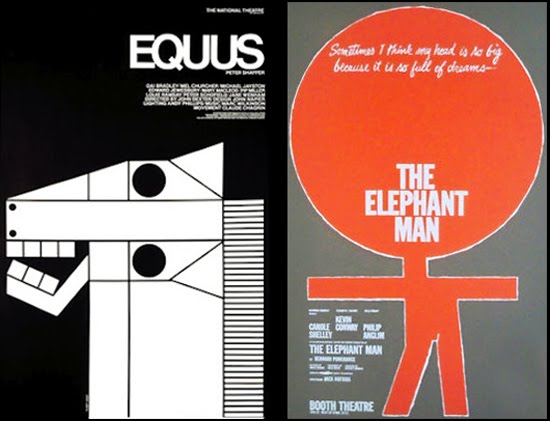
As a little kid in the late '70s and '80s, there were lots of theatrical graphic designers that had a signature look. That really left its mark on me. Gilbert Lesser's posters are iconic — just stark type and geometry (Equus, The Elephant Man…). David Edward Byrd's posters were amazing (Godspell, Follies...). But James McMullen's posters for Lincoln Center Theater are masterpieces. He's the most long-lived resident artist at any theater company, and his works are absolute wonders, capturing the essence of each show (Anything Goes, A Delicate Balance, Carousel… dozens of others…). In the late '80s, when Cameron Mackintosh took over Broadway, posters drifted toward corporate branding (Phantom, Cats, Les Miz...), which has its own kind of storytelling behind it.

I always thought to myself that theatrical illustration seemed like such a wonderful thing to do — capturing the essence of an experience and putting a face on it. And it offered infinite variety. How could you not love that?

It don't pay the bills, but it's a labor of love.

M: What draws you to playing the role of the Emperor?

DC: Oh, there's absolutely NOTHING as fun as playing someone who's essentially a child. That's what theater is about, right? Returning to a sense of play and pretend? Well, the Emperor's just an overindulged, overindulgent little kid who likes shiny things and always wants his way. All the best villains are just overgrown children with moustaches to twirl.

But this one gets to grow up and be a man, too. Big plus.

M: Anything else you'd like to add?

DC: I will add one thing: Doing new work is one of the most thrilling things we get to do in the theater, and we don't do enough of it. We need to take chances more as creators. We need to embrace the new. Doing six thousand productions of Dolly or Seussical or Urinetown is just fine, but helping to birth an entirely new experience for theatergoers? Wow! What a gift!

Thanks for this, Min. We need more of you in the world. I hope someday people are listening to your work while staring at the album cover, amazed.

M: Thank YOU, DC. It's hard to imagine anyone else playing the Emperor for this show. I'll see you at rehearsal.

Posted on September 30, 2013 and filed under Creative, Performing Arts.